I hope you are all well. Since we are all dealing with the ongoing pandemic and the stresses around work and health related concerns, I thought some good news was in order.
First, congratulations to our esteemed President Bethany Saltman who's book "Strange Situation: A Mother's Journey Into The Science of Attachment" made The Washington Post's 10 books to read in April list. Here is a link to The Washington Post for those of you who subscribe and can read it. Go Bethany!
https://www.washingtonpost.com/entertainment/books/ten-books-to-read-in-april/2020/03/31/b7b0a744-737e-11ea-a9bd-9f8b593300d0_story.html
Secondly, WV resident Bonnie LeFave sent me these photos of a pair of eagles that she recently saw down by the intersection of Pantherkill and Woodland Valley roads. These are such beautiful birds! I think the one on the right is a juvenile (see if you other birders agree). We are so lucky to have these majestic creatures in our midst. Thanks for sending us these photos, Bonnie.
So there you have a little good news in the midst of chaos. Stay safe!
Showing posts with label Birds. Show all posts
Saturday, April 11, 2020
Wednesday, February 25, 2015
Loon-acy At Town Hall
Here is an interesting thing that happened yesterday. Several people came to work at Town Hall only to find a loon flapping around the parking lot (see photo below). They captured it and put him/her in a box with a cushion and then called a wildlife rehabilitator to come and get the bird so it could be examined and given the proper medical attention if necessary. When the rehabilitator arrived she said that it actually didn't look injured. She thought it might have just been tired or it had a hard time taking off due to the ice in the creek. But she took it to inspect it further and ultimately release it.
I learned several things about loons when I looked up information on the internet last night. They can't walk well on land. And they need a long stretch of water to take off properly. They are excellent divers and sometimes they are mistaken for cormorants. They have summer plumage and winter plumage which is dramatically different. The feathers on young birds and mature birds in their winter plumage look very much alike (the rehabber thought this might be a young bird). I read that they are so similar that even the experts have a hard time telling them apart during the cold months.
I had never seen a loon up close before. His/her red eyes were amazing. Seeing the bird was a really cool way to start my day yesterday. Hopefully, it wasn't hurt and has been released by now. Bon voyage little loon!
I learned several things about loons when I looked up information on the internet last night. They can't walk well on land. And they need a long stretch of water to take off properly. They are excellent divers and sometimes they are mistaken for cormorants. They have summer plumage and winter plumage which is dramatically different. The feathers on young birds and mature birds in their winter plumage look very much alike (the rehabber thought this might be a young bird). I read that they are so similar that even the experts have a hard time telling them apart during the cold months.
I had never seen a loon up close before. His/her red eyes were amazing. Seeing the bird was a really cool way to start my day yesterday. Hopefully, it wasn't hurt and has been released by now. Bon voyage little loon!
Monday, October 7, 2013
Loving My Bee Balm
Although we still haven't had a hard frost, the growing season here in the valley is coming to a close. At this point I am looking around my property and pondering what I planted that did well and what did not and making plans for next year.
One of the favorite things I grow around my house is Bee Balm (also known as Bergamot). It is native to the Catskills (which is a good thing), spreads well (actually I find it to be slightly invasive) and looks great. And the most amazing extra benefit of it is that the butterflies, bees and hummingbirds (especially the hummingbirds) love it. During the summer I would say there is a hummingbird in it about every 10 minutes.
I thought I would pass my thoughts about this on to the rest of my neighbors. You might want to consider planting some yourselves. That way you can ditch those hummingbird feeders that you have to clean and refill all the time. Plant some bee balm and get the same results. It it bright and cheery and blooms for several months. And you will love having those charming little birds around all day without having to do any work. Just a thought.
Tuesday, September 10, 2013
The Chicken Has Gone Home To Roost
The lost WV chicken seems to have made out better than the lost WV cooler (see several blog posts back). It turned out that the chicken belonged to the Holz farm. Jen Holz went and retrieved the hen this morning. In her last message to me she said that the bird was resting comfortably and dining on pumpernickel and cheese. Ah, there's no place like home!!
Saturday, June 23, 2012
Wrens
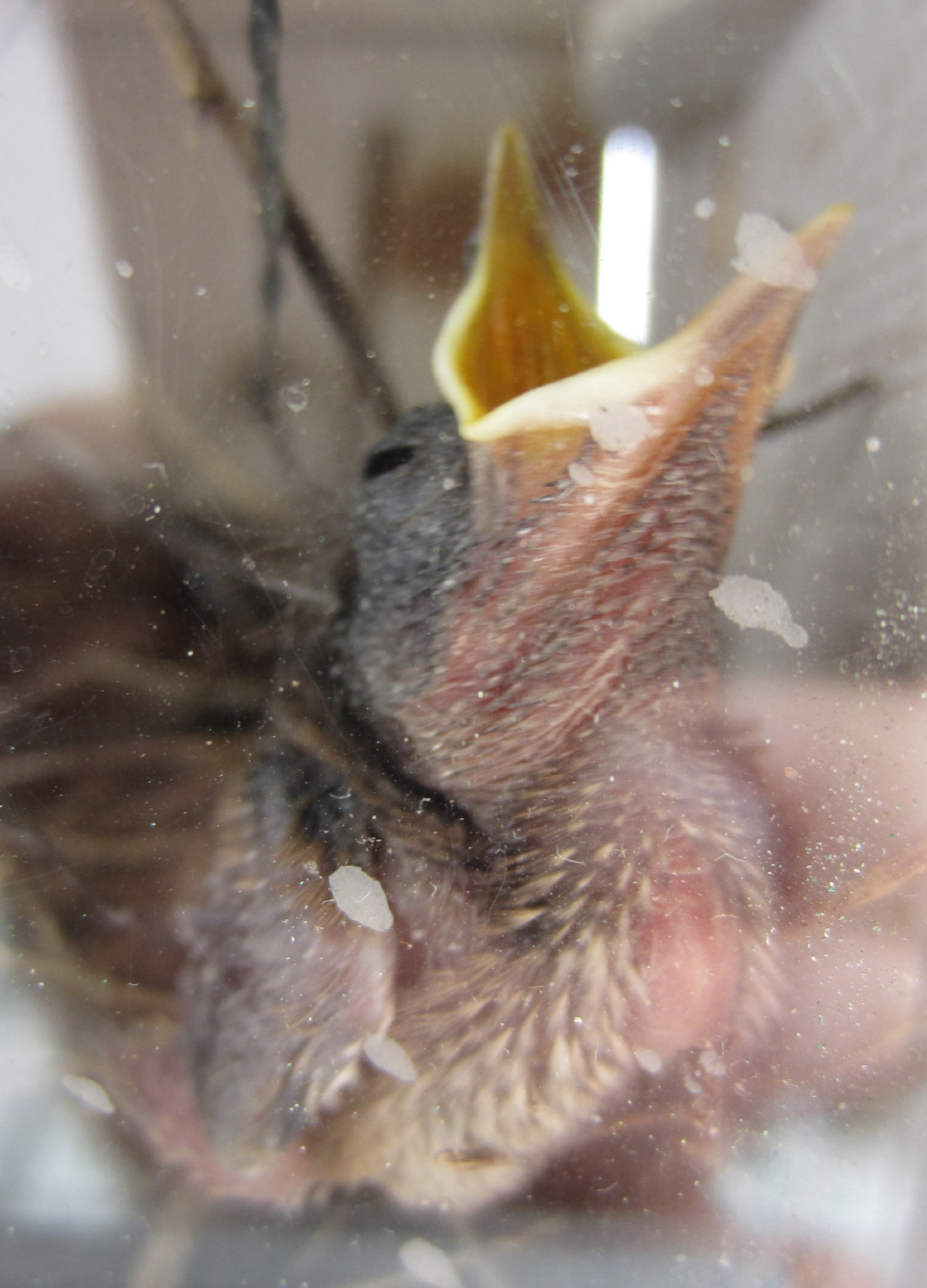
I got this message a few days ago from Paul Misko. Looks like he has new tenants at his house.
"Here are two pics I took yesterday of a wren family. I built this bird box with a removable wood panel so after the birds have signed the lease, I can view the chicks as they grow. It's been busy with the constant delivery of meals. Soon it will be check out time, and they will leave nothing but some memories, nesting material, and an unpaid cable bill."
- Paul
photos by: Paul Misko
Sunday, April 24, 2011
Paradox Or Pair-O-Ducks

Paul Misko sent me this post a couple of days ago. Read on:
While you're on the stream theme, look at what I saw in the upper part of Woodland stream recently. A pair of ducks. They are Common Mergansers, which are an uncommon sight up here, at least to me. According to Peterson's Guide, they have spike-like bills, saw-edged mandibles, and dive for fish. They winter in Mexico. Guess they are waiting for the new shipment of trout on stocking day.
Paul
Thursday, June 24, 2010
Baby Robins
Saturday, April 24, 2010
Monday, April 5, 2010
Who You Calling a Turkey?
Dennis Havel sent me this photo of a turkey in his yard. The birds have been all over my yard too. The other day I had about 9 females (who were grazing) and 3 males (who were fighting with each other). I guess it is that time of year.

Here are some turkey facts from Wikipedia.
The Wild Turkey (Meleagris gallopavo) is native to North America and is the heaviest member of the Galliformes. It is the same species as the domestic turkey, which was domesticated from the South Mexican subspecies of the Wild Turkey.
Adult Wild Turkeys have long reddish-yellow to greyish-green legs and a black body. Males have a large, featherless, reddish head and a red throat, and red wattles on the throat and neck. The head has fleshy growths called caruncles: when males are excited, a fleshy flap on the bill expands, and this, the wattles and the bare skin of the head and neck all become engorged with blood, almost concealing the eyes and bill. Each foot has three toes, and males have a spur behind each of their lower legs.
Turkeys have a long, dark, fan-shaped tail and glossy bronze wings. As with many other species of the Galliformes, turkeys exhibit strong sexual dimorphism. The male is substantially larger than the female, and his feathers have areas of red, purple, green, copper, bronze, and gold iridescence. Female feathers are duller overall, in shades of brown and gray. Parasites can dull coloration of both sexes; in males, coloration may serve as a signal of health. The primary wing feathers have white bars. Turkeys have 5,000 to 6,000 feathers. Tail feathers have the same length in adults, different lengths in juveniles. Males typically have a "beard", a tuft of coarse hair (modified feathers) growing from the center of the breast. Beards average 9 inches (230 mm) in length. In some populations, 10 to 20 percent of females have a beard, usually shorter and thinner than that of the male. The adult male normally weighs from 5 to 11 kg (11–24 lbs) and measures 100–125 cm (39–49 in). The adult female is typically much smaller at 3 to 5.4 kg (6.6–12 lbs) and are 76 to 95 cm (30–37 in) long. The wingspan ranges from 1.25 to 1.44 m (49–57 in). The record-sized adult male Wild Turkey, according to the National Wildlife Turkey Federation, was 38 lb (17.2 kg).

Here are some turkey facts from Wikipedia.
The Wild Turkey (Meleagris gallopavo) is native to North America and is the heaviest member of the Galliformes. It is the same species as the domestic turkey, which was domesticated from the South Mexican subspecies of the Wild Turkey.
Adult Wild Turkeys have long reddish-yellow to greyish-green legs and a black body. Males have a large, featherless, reddish head and a red throat, and red wattles on the throat and neck. The head has fleshy growths called caruncles: when males are excited, a fleshy flap on the bill expands, and this, the wattles and the bare skin of the head and neck all become engorged with blood, almost concealing the eyes and bill. Each foot has three toes, and males have a spur behind each of their lower legs.
Turkeys have a long, dark, fan-shaped tail and glossy bronze wings. As with many other species of the Galliformes, turkeys exhibit strong sexual dimorphism. The male is substantially larger than the female, and his feathers have areas of red, purple, green, copper, bronze, and gold iridescence. Female feathers are duller overall, in shades of brown and gray. Parasites can dull coloration of both sexes; in males, coloration may serve as a signal of health. The primary wing feathers have white bars. Turkeys have 5,000 to 6,000 feathers. Tail feathers have the same length in adults, different lengths in juveniles. Males typically have a "beard", a tuft of coarse hair (modified feathers) growing from the center of the breast. Beards average 9 inches (230 mm) in length. In some populations, 10 to 20 percent of females have a beard, usually shorter and thinner than that of the male. The adult male normally weighs from 5 to 11 kg (11–24 lbs) and measures 100–125 cm (39–49 in). The adult female is typically much smaller at 3 to 5.4 kg (6.6–12 lbs) and are 76 to 95 cm (30–37 in) long. The wingspan ranges from 1.25 to 1.44 m (49–57 in). The record-sized adult male Wild Turkey, according to the National Wildlife Turkey Federation, was 38 lb (17.2 kg).
Wednesday, March 24, 2010
'Through the Window' Series Continues
Dennis Havel has been continuing his 'Through the Window' series and sent me these photos of his most recent subjects. Being a bird watcher myself, I enjoy seeing the varying species that frequent different parts of the valley. I hope you enjoy them too! The top photo features 2 Tufted Titmouse, the middle photo is of a Northern Cardinal sharing a snack with a Nuthatch and the bottom is a beautiful solo photo of a Northern Cardinal. The cardinals in both of these photos are male. The female is much paler, although I think equally as beautiful. Thanks for sending these photos Dennis!!


Saturday, March 20, 2010
The Wren's Nest Going Out of Business

Woodland Valley resident Nancy Heagle has decided to close her birding store, 'The Wren's Nest', located on the boardwalk in Phoenicia. She is still open on weekends until the end of March and she is having a big 'Going Out of Business' sale. There are big discounts on all items in the store! Stop by and check it out. You can stock up on everything you need for a great birding experience. She even has binoculars for those of you who want to head over to the reservoir and check out the nesting eagles. So go on down to town today and take advantage of a great sale!
Sunday, January 24, 2010
More on the Owl
Last week, after Rolf Reiss sent me the photo of the owl he had seen in his backyard during the day, I had a chance to look at the picture a little more closely. I noticed that the owl's right eye was slightly closed indicating that he might have injured it in some way. I emailed Rolf and we both thought that maybe he had vision problems and didn't get enough food at night and that was why he was hunting in the daylight. It is just a theory though so I am putting the photo up and you can all see what you think.
As a sidebar, one of my friends in Mt. Tremper has also seen an owl in her backyard in the daytime. I wonder if it could be the same one? I am not sure as to the extent of their hunting range. If anyone out there can share more information that would be great.
Monday, January 11, 2010
Barred Owl

There has been another cool bird sighting in the valley Rolf Reiss sent me this.
"A couple of weeks ago while walking down Woodland Valley Road in the middle of the day I saw what I thought was a hawk land in a tree about 200 feet in front of me. It stayed in the tree until I reached it and realized that it was not a hawk but a barred owl with a red squirrel in it's talons. It remained there as I walked away thinking about how odd it was to see an owl hunting in broad daylight. Sure enough after arriving at home I got out my Sibleys field guide to birds where it described the barred owl as " Usually solitary. Nocturnal. Hunts at night for small mammals. A relatively stocky, medium -size owl."
This past Sunday which was cold and windy with snow showers I was standing at my back door just admiring the beauty of the day when out of nowhere an owl landed on the ground about 7 feet from where I stood. I was very lucky to get some photos of this wondrous visitor. It stayed watching the small birds come and go from our bird feeder for quite a while before flying off.
I suspect that it may very well have been the same owl I had seen along the road a few weeks earlier. Has anyone else seen this "nocturnal" beauty?"
- Rolf
Saturday, January 9, 2010
Winter Birds
Dennis Havel sent me this beautiful photo of a blue jay in his yard. I love the birds that choose to winter in our area. Although I don't put out any seed in the summer because of the bears, I do put it out in the winter. It always brings a crowd. Although I like the blue jays I especially like the chickadees. They are bold little creatures. A couple of years ago one actually landed on the bag of seed I was carrying and tried to get a head start into the treats. It was awesome!!
Saturday, June 20, 2009
Deserving Dad
This just in from WCA member Paul Misko.
"Last year I built a new bird house and designed it with a picture window which would face my porch. A solid wood panel remains in place at first so the newlywed birds don't hesitate to move in. After the nest is built and the eggs are laid, I can simply slide out the solid board and gain a clear view of the nest. Here is a shot of the five chicks inside, and one of Dad outside wondering how he's going to feed all those hungry mouths. He's also keeps busy chasing away the bluejays that try to steal the chicks. He certainly deserves a nice Father's Day Gift, instead of a "cheep" one."
- Paul

"Last year I built a new bird house and designed it with a picture window which would face my porch. A solid wood panel remains in place at first so the newlywed birds don't hesitate to move in. After the nest is built and the eggs are laid, I can simply slide out the solid board and gain a clear view of the nest. Here is a shot of the five chicks inside, and one of Dad outside wondering how he's going to feed all those hungry mouths. He's also keeps busy chasing away the bluejays that try to steal the chicks. He certainly deserves a nice Father's Day Gift, instead of a "cheep" one."
- Paul

Tuesday, March 10, 2009
Bald Eagles in Woodland Valley
I got this message from Nat Gillespie yesterday and thought you would all be interested.
"I wanted to tell you and the blog that I was up in the Valley last week, and my cousin Jamie and I were sitting on the porch around lunchtime when we spotted a pair of mature bald eagles circling Woodland Valley Creek across the road. We watched them for about 10 minutes and then they disappeared. Maybe they are building a nest in one of the large white pines on Romer Mountain."
- Nat
Actually, Harry Jameson has told me that they have nested on Romer Mountain in the past. Let's hope they decide to settle there again this year. If anyone else has a siting let me know. Thanks for keeping us posted Nat.
"I wanted to tell you and the blog that I was up in the Valley last week, and my cousin Jamie and I were sitting on the porch around lunchtime when we spotted a pair of mature bald eagles circling Woodland Valley Creek across the road. We watched them for about 10 minutes and then they disappeared. Maybe they are building a nest in one of the large white pines on Romer Mountain."
- Nat
Actually, Harry Jameson has told me that they have nested on Romer Mountain in the past. Let's hope they decide to settle there again this year. If anyone else has a siting let me know. Thanks for keeping us posted Nat.
Friday, September 5, 2008
Open Mouths to Feed

Last Saturday, much to my distress, my cat came running towards me with a fledgling Cedar Waxwing in her mouth. Thank goodness I was able to get it away from her immediately. I called Joanne Rowley, the wonderful wildlife rehabilitator in Phoenicia. She said that I could release the bird unless it had puncture wounds from the cat's teeth. Unfortunately, she did, so I fed her (about every half hour) until Joanne could see her later in the day and give her antibiotics. It was lucky that she was easily identified because I knew exactly what she needed to eat. I took care of her all day Sunday too until Joanne could take her in Sunday night. See seems to be doing very well. She needs to stay on the antibiotics for about a week until the danger of infection passes. We plan to release her over the weekend. We would have done it Saturday but with the remnants of the hurricane passing through we have decided to wait.
We are lucky to have Joanne right here in our town. She does amazing work with creatures of all kinds. Right now she is also caring for 7 little flying squirrels that someone found in a tree they cut down. They were about a week old when they were brought to her. They are sooooo cute. She has to get up every few hours round the clock to feed them. What commitment!! At present she is caring for about 30 creatures of all kinds. When I go there I fell like I am visiting St. Francis.
I brought 2 nestlings to her last year when the tree with their nest came falling down onto WV road. I thought they were Blue Jays but they turned out to be Flickers. She and her network of rehabilitators raised them and they were released. Again, we (and all the injured and abandoned animals) are lucky to have such a caring person in our midst.

Doesn't she look like she is saying "Huh??"
PS - I want to take this opportunity to tell everyone that cat bites are EXTREMELY serious and almost always cause infection. I myself was 24 hours from being hospitalized with a bite from one of my own cats. When she bit me I cleaned the wound and put topical antibiotics on it for a full week but my leg got severely infected. Finally, I went to the doctor and he gave me a strong antibiotic but I had waited too long. Over the next four days my leg got progressively worse and I had to go to the emergency room and get a second even more powerful antibiotic. They told me at that time that if the infection did not start getting better in 24 hours that I would have to be checked in and given intravenous antibiotics. Thankfully, the second drug worked and it didn't come to that, but I am here to tell you that if you get bit by a cat seek medical attention immediately!
Sunday, August 17, 2008
The Pantherkill Report - Hummingbirds
Here is another installment of the Pantherkill Report from Dennis Havel.
"I have a hummingbird feeder hanging just outside the window above my desk and have been watching these neat little aerial speedsters close-up all Summer. I happened to mention this to a few people who proceeded to educate me on the finer points of Archilochus colubris, better known as the Ruby-Throated Hummingbird.
These well-meaning folks told me stuff about the hummers that seemed more than a little implausible, so I turned to my trusty Googler to find the straight scoop:
Goofy Fact #1 - Hummingbirds have no legs.
Huh? Wha? This commonly believed myth is totally bogus and a little critical thinking should explain why. If this is true, why do hummingbird feeder manufacturers bother to put little plastic perches on the feeders?

This is a hummingbird foot.
Goofy Fact #2 - Hummingbird beaks are really a tube
"Bzzzzzzzt, Wrong! Thank you for playing. Don Pardo, what consolation gifts do we have for our loser?
Merv, we have this beautiful photo of a hummingbird beak showing the tongue lapping liquid just like a cat. No sucking through a mythical tube-beak here!"

Goofy Fact #3 - Hummingbirds migrate by hitching a ride on the backs of Canada geese.
Yeah. Sure. And, they get a complimentary beverage and in-flight movie!
The Canadian Goose migrates South to Virginia, North and South Carolina and flies at altitudes up to 29,000 feet where the oxygen is thin and temperatures are well below freezing. They are well adapted for these conditions having large lungs and lots of body fat. The hummer, being no bigger than a medium gherkin pickle, lacks lung capacity and body fat to survive at these altitudes.
In addition, the hummers migrate to Central America and Southern Mexico. They fly the entire route at treetop level and then across the Gulf of Mexico just inches above the surface.
If the hummer hitched a ride on a Canadian Honker, he'd have to change gooses at Richmond, Virginia and would probably arrive in Coast Rica without his luggage.
The most obvious fact that debunks this myth is that, while hummers do have feet, they lack thumbs with which to indicate their need for a ride.

Canadian Goose hitching a ride to Puerto Vallarta on the head of a hummingbird."
Thanks Dennis for this funny and informative post!
"I have a hummingbird feeder hanging just outside the window above my desk and have been watching these neat little aerial speedsters close-up all Summer. I happened to mention this to a few people who proceeded to educate me on the finer points of Archilochus colubris, better known as the Ruby-Throated Hummingbird.
These well-meaning folks told me stuff about the hummers that seemed more than a little implausible, so I turned to my trusty Googler to find the straight scoop:
Goofy Fact #1 - Hummingbirds have no legs.
Huh? Wha? This commonly believed myth is totally bogus and a little critical thinking should explain why. If this is true, why do hummingbird feeder manufacturers bother to put little plastic perches on the feeders?

This is a hummingbird foot.
Goofy Fact #2 - Hummingbird beaks are really a tube
"Bzzzzzzzt, Wrong! Thank you for playing. Don Pardo, what consolation gifts do we have for our loser?
Merv, we have this beautiful photo of a hummingbird beak showing the tongue lapping liquid just like a cat. No sucking through a mythical tube-beak here!"

Goofy Fact #3 - Hummingbirds migrate by hitching a ride on the backs of Canada geese.
Yeah. Sure. And, they get a complimentary beverage and in-flight movie!
The Canadian Goose migrates South to Virginia, North and South Carolina and flies at altitudes up to 29,000 feet where the oxygen is thin and temperatures are well below freezing. They are well adapted for these conditions having large lungs and lots of body fat. The hummer, being no bigger than a medium gherkin pickle, lacks lung capacity and body fat to survive at these altitudes.
In addition, the hummers migrate to Central America and Southern Mexico. They fly the entire route at treetop level and then across the Gulf of Mexico just inches above the surface.
If the hummer hitched a ride on a Canadian Honker, he'd have to change gooses at Richmond, Virginia and would probably arrive in Coast Rica without his luggage.
The most obvious fact that debunks this myth is that, while hummers do have feet, they lack thumbs with which to indicate their need for a ride.

Canadian Goose hitching a ride to Puerto Vallarta on the head of a hummingbird."
Thanks Dennis for this funny and informative post!
Labels:
Birds,
Fun Facts,
Pantherkill